Why Do I Overthink Everything at Night?
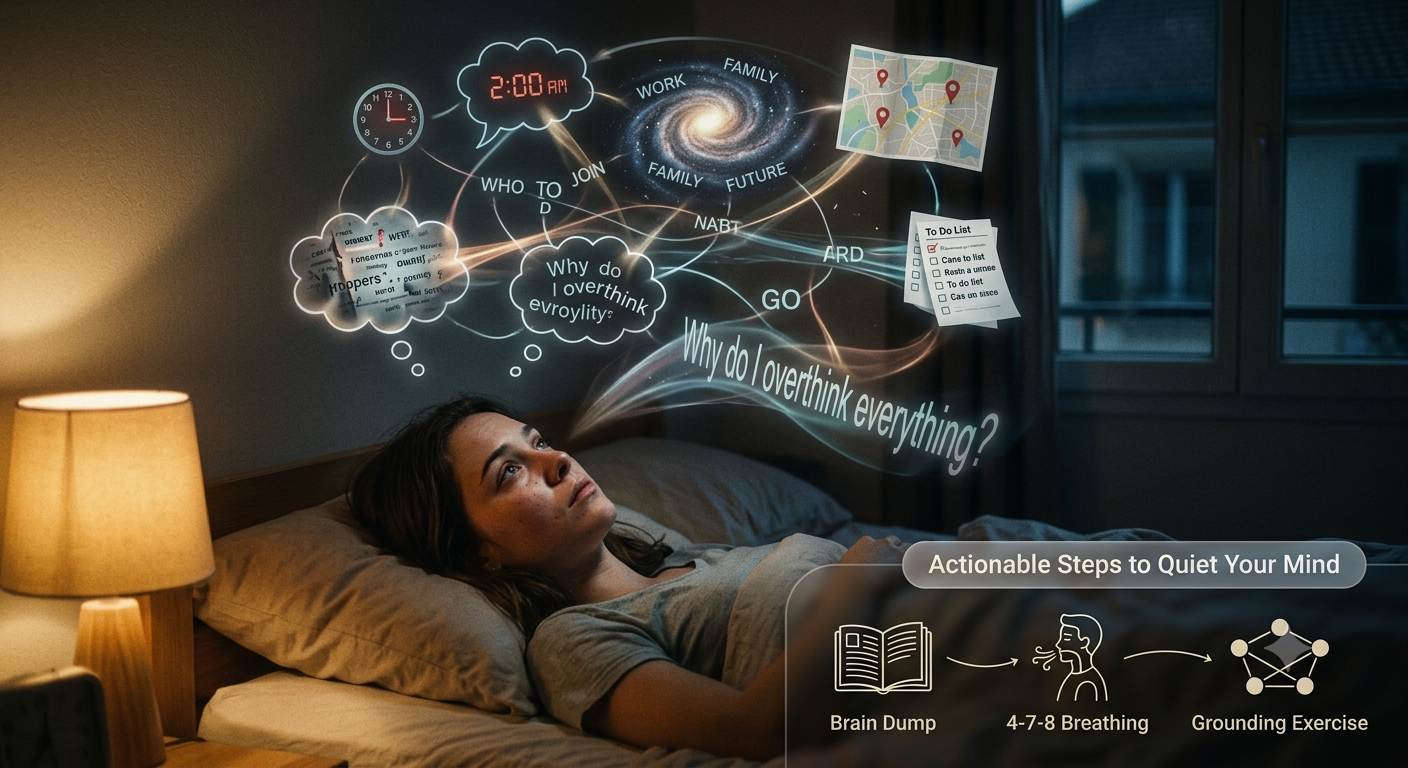
Why Do I Overthink Everything at Night?
How to Quiet Your Mind?
Have you ever noticed how your brain suddenly decides to replay an awkward conversation from three years ago the exact moment your head hits the pillow? You lie awake for hours, staring at the ceiling, wondering: Why do I overthink everything at night? If this sounds familiar, you are definitely not alone. The midnight mental marathon is a deeply frustrating experience that leaves you feeling exhausted before the next day even begins.
In this article, you will discover the psychological reasons behind nighttime overthinking. You will also learn practical, mindfulness-based strategies to calm your racing thoughts so you can finally get the restful sleep you deserve.
The Hidden Psychology Behind Nighttime Overthinking
To stop the cycle of late-night mental loops, you must first understand why your brain chooses the midnight hour to go into overdrive.
During the daytime, your mind is constantly occupied. You are answering emails, interacting with family, scrolling through your phone, or managing daily chores. This constant stream of stimuli acts as a natural distraction. It keeps your deeper anxieties and unprocessed emotions pushed beneath the surface.
When you turn off the lights and eliminate all external distractions, the silence can feel deafening. Your brain suddenly loses its daytime distractions, which creates a blank canvas for every buried thought to emerge.
Furthermore, your brain chemistry naturally changes as the sun goes down. Your frontal cortex, which handles logic and emotional regulation, becomes tired after a long day. This exhaustion lowers your cognitive defenses, which allows your inner critic to take center stage.
The Evolution of the Midnight Mind
From an evolutionary standpoint, your brain is wired to keep you safe rather than happy [1]. When you are tired and alone in the dark, your primitive nervous system can mistake psychological stress for physical danger.
Your mind begins to scan your life for potential threats. This survival mechanism manifests as a flood of worrisome questions about your job, your relationships, or your future.
Actionable Tips to Stop Overthinking at Night
Fortunately, you do not have to be a victim of your racing mind. By implementing a few practical mindfulness techniques, you can train your brain to transition smoothly into deep relaxation.
1. Establish a Dedicated "Brain Dump" Routine
One of the most effective ways to clear your mind is to write down your thoughts before you get into bed.
The Practice: Sit down with a journal thirty minutes before sleep. Write down everything that is bothering you, including your to-do list for tomorrow, your current worries, and any lingering frustrations.
The Example: Imagine you are stressing about a difficult project at work. Instead of looping the problem in your head, write down: "I am worried about tomorrow's presentation, but I will review my notes at 9:00 AM."Physically moving the thoughts from your head to the paper signals to your brain that the information is safe, which allows your mind to let go.
2. Practice the 4-7-8 Breathing Technique
When overthinking triggers a stress response, your body enters a mild state of fight-or-flight. You can counteract this physical reaction by consciously changing your breath pattern.
The Practice: Inhale through your nose for a count of four seconds. Hold your breath for a count of seven seconds. Exhale completely through your mouth with a whoosh sound for a count of eight seconds. Repeat this cycle four times.
The Science: Clinical research shows that structured breathwork stimulates the vagus nerve [2]. This stimulation activates your parasympathetic nervous system, which naturally lowers your heart rate and halts the production of stress hormones.
3. Use Mindfulness Grounding Exercises
If you catch yourself overthinking in bed, gently shift your attention away from your thoughts and into your physical body.
The Practice: Try the "5-4-3-2-1" sensory method adapted for the dark. Acknowledge five points of physical contact between your body and the mattress. Notice four distinct sounds in your environment, such as a fan or distant traffic. Identify three physical sensations, like the warmth of your blanket. Recognize two scents in the room, and notice one deep breath moving through your lungs.
The Example: Instead of analyzing a tense conversation with a friend, focus completely on the cool texture of your pillowcase. Grounding yourself in the present moment breaks the abstract loop of overthinking.
The Scientific Proof: Why Mindfulness Works
Modern psychology heavily supports the use of mindfulness to combat sleep disturbances. Studies show that repetitive negative thinking is a primary driver of insomnia [3].
When you practice mindfulness, you learn to observe your thoughts without judging them or reacting to them. You begin to realize that just because you have a stressful thought at 2:00 AM does not mean that thought represents reality.
Historical wisdom has echoed this truth for centuries. Ancient mindfulness traditions teach that the mind is like a turbulent ocean. You cannot stop the waves, but you can learn how to surf. By changing your relationship with your thoughts, you can find a sense of inner peace right in the middle of the night.
Deepen Your Journey to Restful Sleep
Overcoming nighttime overthinking is a journey that requires patience, consistency, and self-compassion. If you want to accelerate your progress and build a sustainable evening routine, guided meditation can be an incredibly powerful tool.
You can explore a variety of calming sleep meditations, deep relaxation practices, and mindfulness courses designed to soothe your mind on my official profile.
Discover My Online Courses and start waking up feeling truly refreshed.
Sources
[1] American Psychological Association. (2022). The Evolutionary Roots of Anxiety and Stress.
[2] Harvard Medical School. (2020). Relaxation techniques: Breath control helps quell errant stress responses.
[3] Journal of Behavior Therapy and Experimental Psychiatry. (2019). The role of repetitive negative thinking in sleep disturbance.