Night Anxiety: What It Is and Why It Happens
The house grows completely quiet, you switch off the final lamp, and you place your head on the pillow after a truly exhausting day. Instead of drifting into a restful sleep, you suddenly experience a heavy wave of dread, panic, or physical restlessness. Your heart beats faster, your muscles tighten, and your mind rapidly replays past conversations or loops through a long list of tomorrow's obligations.
If you regularly face this frustrating pattern, you are not alone. Millions of individuals experience night anxiety, which is a highly specific form of emotional distress that peaks precisely when your body is meant to rest. This article will break down exactly what night anxiety is, explain the psychological and biological reasons why it happens, and provide six practical, actionable tips to help you reclaim your evening peace.
Why Your Mind Races When the World Goes Quiet
To overcome this exhausting loop, we must understand the primary mechanics of night anxiety and why it happens. During the daylight hours, your brain stays constantly occupied with professional projects, family responsibilities, digital entertainment, and social interactions. This continuous stream of external input creates a functional layer of mental noise. This busy noise effectively suppresses your underlying fears, unexpressed worries, and daily stresses.
The situation shifts dramatically when you lie down in a dark, silent room. Because your mind suddenly lacks any external distractions to occupy its attention, your brain finally attempts to process the stored tension from your day.
Your physical biology also undergoes a major transition as evening approaches. Your body naturally decreases its production of cortisol, which is a key hormone that helps regulate your response to stressful events [1]. When your internal cortisol level drops alongside a rise in melatonin, your emotional brain becomes significantly more sensitive to underlying worries. Your subconscious mind often misinterprets the simple emptiness of a quiet bedroom as an active threat, which triggers a false fight-or-flight response right when you are most vulnerable.
6 Actionable Real-Life Tips to Calm Your Mind and Body Before Sleep
1. Establish a Nighttime Brain-Dump Journaling Routine
You should never force your subconscious mind to hold onto unresolved details when you are trying to rest. Keep a physical notebook on your nightstand and write out your active concerns before you turn off your lights.
A Real-World Example: Consider Clara, an independent business owner who struggled with overwhelming chest tightness every single night. She frequently woke up at one in the morning, because she felt terrified that she would miss a crucial client deadline. Clara started a new habit where she spent ten minutes writing out every single pending task and lingering worry before she brushed her teeth. By transferring her thoughts safely onto paper, she proved to her survival brain that her responsibilities were securely recorded for the morning.
2. Transition Your Nervous System with a Sensory Buffer Zone
Your body cannot instantly switch from a high-pressure environment into deep, restorative sleep. Build a dedicated transition period that lasts for at least forty-five minutes before you crawl into bed. Turn off all television screens, put away your smartphone, and dim your household lighting to signal your brain that the active day is officially over.
3. Utilize the 4-7-8 Somatic Breathing Method
When you feel a sudden surge of physical panic under the covers, you must soothe your brain by using your physical body. The 4-7-8 breathing practice acts as a direct off-switch for your sympathetic nervous system, which lowers your heart rate and reduces pre-sleep arousal.
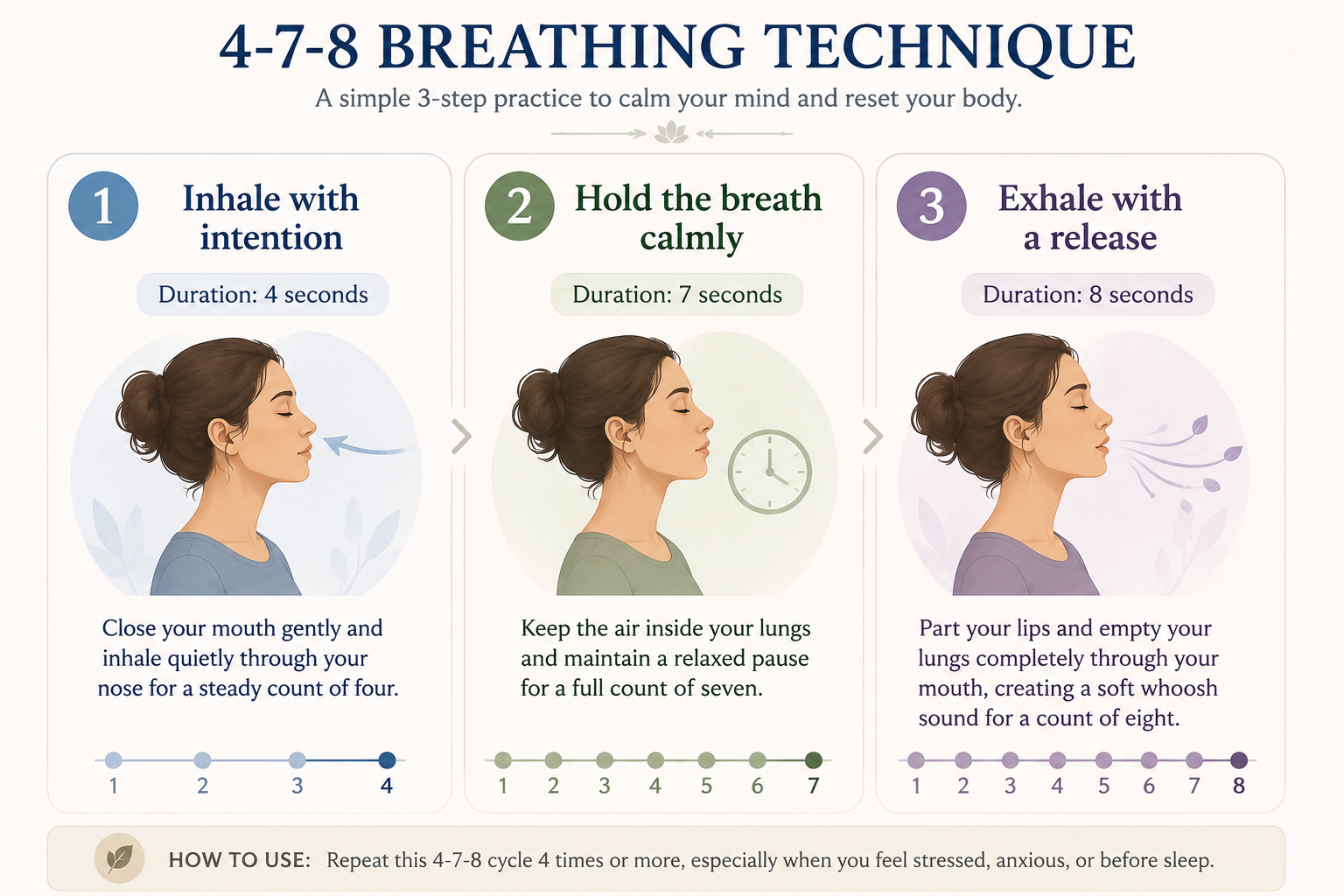
4-7-8 breathing technique infographic
4. Separate Your Physical Body from Your Bed During Panic Loops
If you remain in bed for more than twenty minutes while your mind races, you create a negative psychological association. Your brain begins to view your mattress as a place of frustration rather than a place of rest. Get out of bed, move to a dimly lit chair in another room, and engage in a quiet activity until your body feels sleepy again.
5. Practice the Progressive Muscle Relaxation Technique
Anxiety stores massive amounts of physical tension in your jaw, shoulders, and neck. Before you close your eyes, spend a few minutes systematically tensing and relaxing each muscle group from your toes up to your forehead. This contrast teaches your body what true physical relaxation feels like.
6. Introduce a Mindful Body Scan Before Your Eyes Close
Instead of allowing your awareness to wander into future worries, anchor your attention firmly within your physical form. Close your eyes and notice the sensation of your blankets pressing against your skin. Track the subtle movement of your abdomen with each breath, which keeps your mind safely occupied in the present moment.
The Scientific Reality of Pre-Sleep Arousal
Clinical research repeatedly confirms that dedicated mindfulness interventions can successfully interrupt severe sleep disruptions. A major study published in JAMA Internal Medicine monitored adults who faced chronic nighttime wakefulness and elevated stress [2]. The individuals who received consistent mindfulness training experienced profound improvements in their overall sleep quality, recorded lower rates of insomnia, and reported fewer episodes of mid-night panic than the control group.
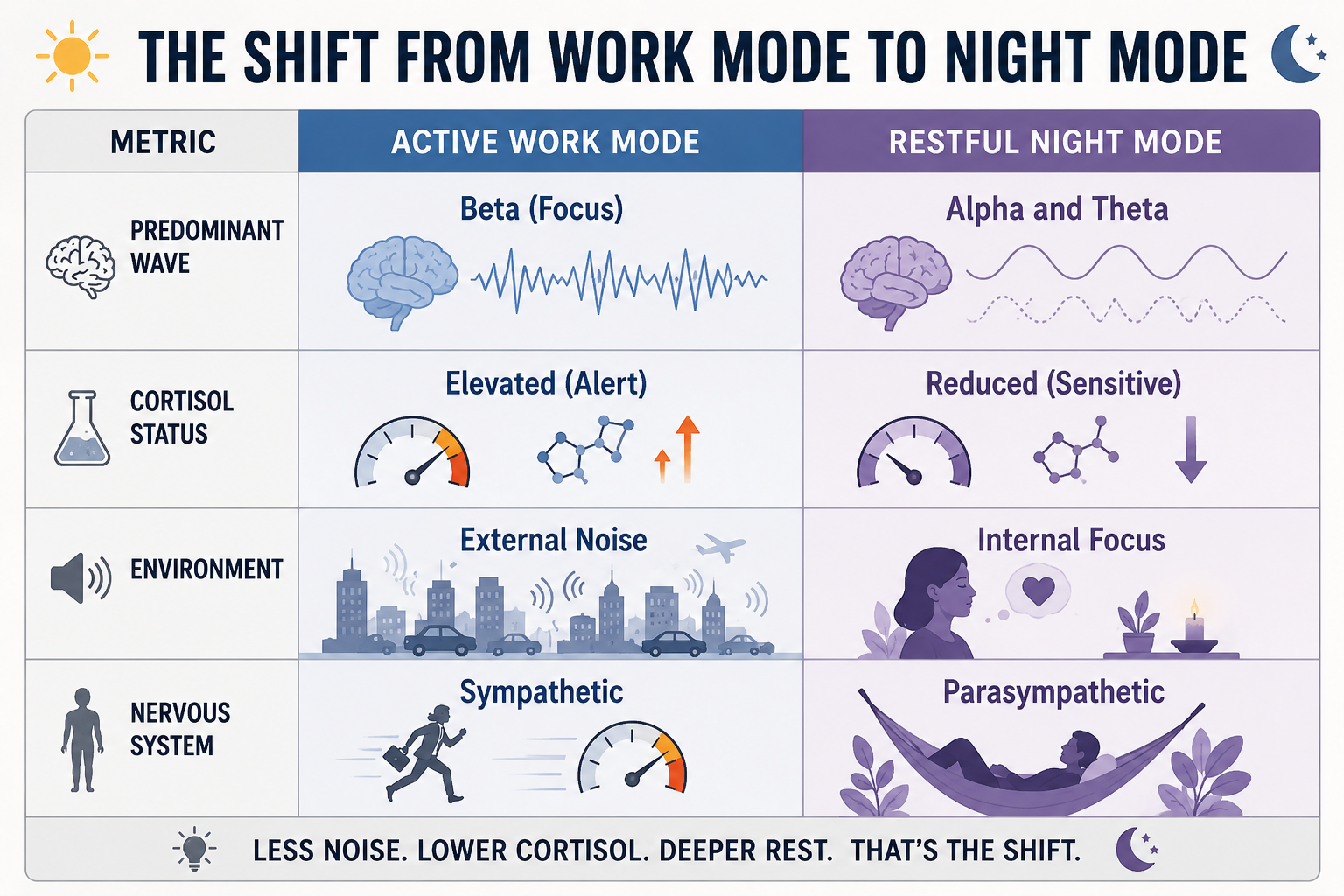
The shift from work to night mode
Advanced neuroimaging studies show that persistent sleep anxiety keeps your amygdala in a hyper-reactive state [3]. This constant emotional alarm prevents your brain waves from shifting safely into slow-wave delta sleep, which is the specific sleep stage that is necessary for cellular repair and emotional processing [4]. By implementing daily grounding exercises, you build stronger regulatory pathways between your prefrontal cortex and your emotional center, which allows you to approach the darkness with genuine ease.
Deepen Your Practice and Master Your Evenings
Overcoming night anxiety is a gentle process that requires regular practice, immense self-compassion, and the proper guidance. You do not have to spend your nights staring helplessly at the ceiling while your thoughts spin out of control.
I invite you to explore my online courses, where we focus specifically on retraining the nervous system to welcome emotional rest. Together, we will walk through soothing body scans, quiet your inner critic, and build an unshakeable inner sanctuary that allows you to drift into a deep, peaceful sleep every single evening.
Sources
[1] Nater, U. M., et al. (2007). Daily schedules of salivary cortisol and alpha-amylase in youth with anxiety disorders. Journal of Psychiatric Research, 41(11), 914-921.
[2] Black, D. S., et al. (2015). Mindfulness meditation in sleep quality for older adults with sleep disturbances: A randomized clinical trial. JAMA Internal Medicine, 175(4), 494-501.
[3] Riemann, D., et al. (2010). The psychobiology of insomnia: Hyperarousal and its causes. Sleep Medicine Reviews, 14(1), 19-31.
[4] Walker, M. P. (2017). Why We Sleep: Unlocking the Power of Sleep and Dreams. New York: Scribner.