Why Some People Fear Healthy Love: Overcoming the Anxiety of Emotional Safety
Have you ever spent years wishing for a kind, stable, and consistent partner, only to feel an overwhelming urge to run away when that person finally arrived? You might find yourself picking them apart over completely minor flaws. You may even feel a strange sense of boredom because there is no dramatic tension or conflict to fuel the romance. This internal tug-of-war can leave you feeling deeply confused, isolated, and broken.
It is incredibly frustrating to consciously desire a loving intimacy while your subconscious mind actively sabotages your relationships. If you find yourself pulling back from someone who treats you with genuine respect, you are experiencing a very common psychological defense mechanism. This guide will explore the deep reasons why some people fear healthy love, examine how your past conditioning creates this automatic anxious reaction, and provide five practical, life-changing tips to help you embrace emotional safety.
Why Predictable Kindness Triggers Our Alarm Systems
To understand why some people fear healthy love, we must look at how the human nervous system defines safety. Your subconscious mind always prioritizes familiarity over genuine well-being. If your early caregivers or past romantic partners were chaotic, unpredictable, or emotionally distant, your brain mapped that high-stress environment as the baseline definition of love.
Psychologists rely on attachment theory to explain this specific behavior [1]. When you grow up in an environment where you must constantly perform or chase after someone to receive affection, your brain associates love with chronic hypervigilance. In adulthood, you might actually confuse a total lack of chaos with a lack of chemistry or passion.
When a healthy partner enters your life with open communication, clear boundaries, and steady affection, your internal survival systems sound an alarm. Safe, predictable love requires real vulnerability, and vulnerability carries the inherent risk of being truly seen. For an individual who carries deep emotional wounds, being seen feels like an open invitation to be abandoned, manipulated, or controlled. Your current panic is not a rational assessment of your partner, because it is an automated protective response to the unfamiliar experience of emotional peace.
5 Actionable Tips to Heal Your Relationship with Emotional Safety
1. Refine Your Emotional Vocabulary
Begin by actively shifting how you label your romantic feelings. When you notice a sudden impulse to distance yourself from a loving partner, pause and investigate the root cause. Ask yourself if you are truly incompatible, or if you are simply experiencing a temporary lack of familiar relationship anxiety.
A Real-World Example: Consider Mark, an architect who spent his entire adult life chasing emotionally distant partners. When he began dating Julia, a woman who communicated openly and showed consistent kindness, Mark felt an intense urge to break off the relationship because he felt bored. After a mindful pause, he realized that his past relationships kept his body flooded with stress hormones. He was confusing that exhausting physical anxiety with romantic excitement. Julia's stability only felt boring because it did not trigger his old defense systems.
2. Expand Your Tolerance for Peace via Somatic Grounding
Your mind will always invent logical excuses to run away when your body feels overwhelmed by unexpected intimacy. When your partner offers a genuine compliment or demonstrates reliable behavior, try to track your physical reactions in real time.
Notice if you experience a tightening in your stomach, or if you feel a sudden urge to deflect the conversation with a joke. Take a slow, intentional breath and allow the comforting moment to land in your body. Data confirms that somatic grounding techniques can successfully retrain the amygdala to recognize that physical calmness is completely safe [2].
3. Share Your Internal Fears with Radical Honesty
You do not have to hide your relationship anxiety from a supportive partner. Let them know that you are actively learning to navigate healthy connections, and request a collaborative pace that respects your nervous system.
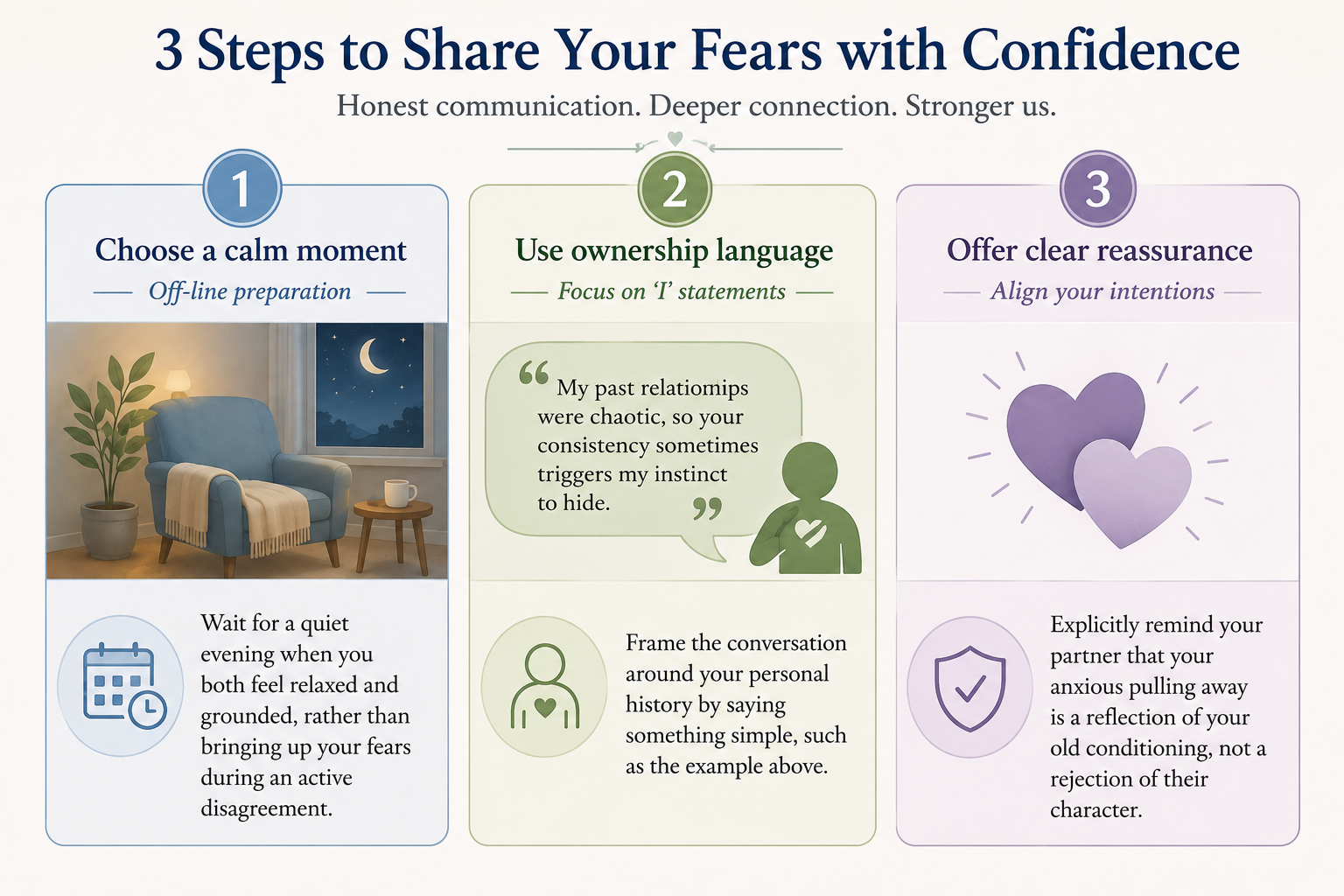
3 steps to share your fears
4. Challenge Your Unconscious Flaw-Finding Mission
When healthy love begins to feel uncomfortably close, your ego will often look for arbitrary reasons to reject the other person. You might judge their style of dress, their laughter, or their hobbies to create emotional distance.
Catch yourself when you enter this hyper-critical mindset. Write down a list of their core qualities, such as emotional maturity, integrity, and kindness. Remind yourself that your brain is simply manufacturing flaws to protect you from the perceived danger of deep intimacy.
5. Cultivate a Daily Self-Validation Practice
Many people reject healthy love because they do not believe they are inherently worthy of being cherished. If you rely entirely on a partner to build your self-esteem, you will always live in fear of losing their approval.
Dedicate five minutes every morning to checking in with yourself through mindful presence. Place a hand over your heart and repeat a grounding phrase: "I am safe, I am whole, and I am fully worthy of a peaceful, loving connection."
The Scientific Reality of Relationship Sabotage
The tendency to pull away from safe relationships is deeply rooted in our neurobiology. Research shows that chronic emotional stress and relationship instability alter our neural reward pathways [3]. When we become accustomed to the intense dopamine spikes that follow a dramatic reconciliation after a massive argument, a stable partnership can initially feel devoid of neurological reward.
Furthermore, landmark clinical studies indicate that a persistent fear of intimacy is frequently tied to an avoidant or disorganized attachment style [4]. These structural defense mechanisms develop during infancy and childhood to protect us from parental rejection.
The wonderful news is that your attachment style is not a fixed sentence. Through consistent mindfulness, conscious self-awareness, and intentional emotional retraining, you can develop earned security. This psychological shift allows you to gradually rewire your neural pathways, calm your overactive nervous system, and finally view healthy love as a peaceful sanctuary rather than a terrifying trap.
Deepen Your Capacity for Safe Intimacy
Learning to accept a healthy relationship is a profound act of courage. It requires you to lay down your oldest emotional shields, trust the process of healing, and believe that you deserve to be loved without needing to constantly fight for it.
I invite you to explore my online courses, where we focus specifically on healing attachment wounds and retraining the nervous system for deeper presence. Together, we will practice guided meditations that open the heart, soothe the fear of vulnerability, and help you step confidently into the safe, fulfilling love that you truly deserve.
Sources
[1] Bowlby, J. (1982). Attachment and loss: Vol. 1. Attachment. New York: Basic Books.
[2] Levine, P. A. (2010). In an unspoken voice: How the body releases trauma and restores goodness. Berkeley: North Atlantic Books.
[3] Fisher, H. E., et al. (2010). Reward, addiction, and emotion regulation systems associated with rejection in love.Journal of Neurophysiology, 104(1), 51-60.
[4] Mikulincer, M., & Shaver, P. R. (2007). Attachment in adulthood: Structure, dynamics, and change. New York: Guilford Press.